 Skip to content
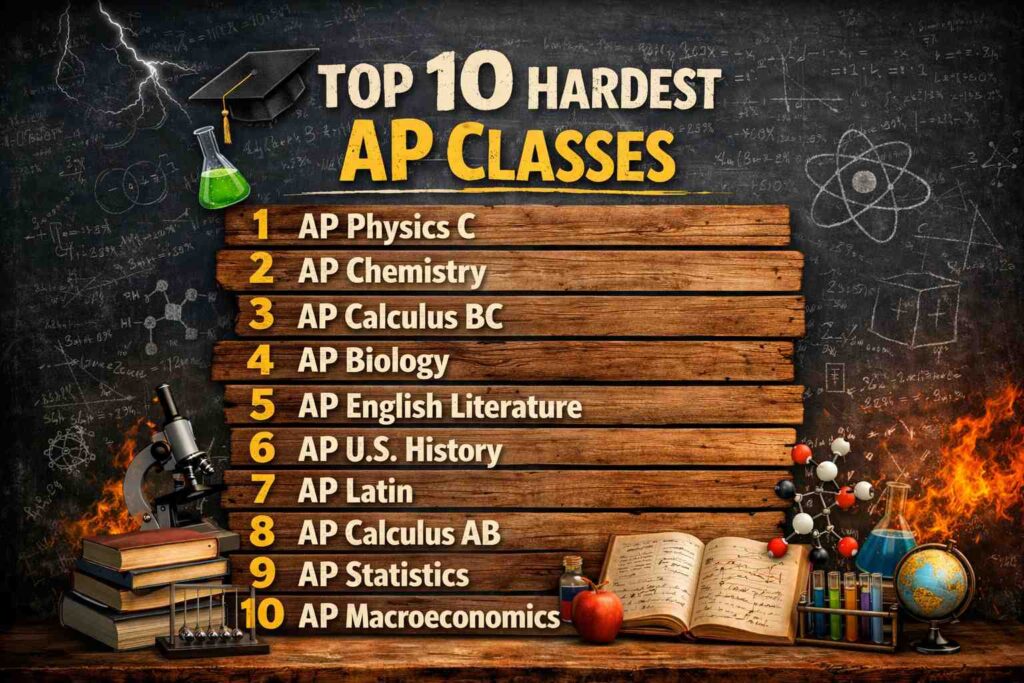
Choosing AP classes for your high school course schedule feels like playing Tetris—each period must fit perfectly. Students often ask: which are the hardest AP classes? The truth is, course difficulty varies based on your strengths, but AP Biology, AP Calculus, AP United States History, and AP English Language and Composition consistently challenge learners.
What makes Advanced Placement classes genuinely difficult? It’s not just the final exam or AP score. These challenging coursework options demand college readiness skills across different subjects simultaneously. Your school counselor can help navigate this, but understanding how classes interact in your schedules prevents academic breakdown.
Before making informed decisions about popular offerings, consider this: AP class difficulty ranking lists miss personal context. Elite college AP coursework goals and college credit aspirations matter, but the sequence and considerations around your specific strengths determine success. Smart students evaluate blocks of time, not just individual class difficulty.
What are AP Classes in High School?

AP classes are advanced courses offered by the College Board that prepare students for college level work in high school. These classes cover difficult curriculum across Math, science, literature, and history. At the end of the year, students take an AP exam to earn credit.
The hardest AP subjects remain entirely relative to individual strengths—Math whizzes struggle with writing-intensive courses like AP English Literature or US History, while literary gurus balk at AP Physics or Chemistry. Building a schedule requires honest assessment of what feels comfortable.
Students must factor their goals when choosing AP courses. If you hope to pursue hard sciences, taking Physics 1, AP Chem, or Biology gives a head start. Experienced AP teachers with solid track records of 4s and 5s make preparation easier than self-studying without instructor guidance.
AP Classes vs. Dual Enrollment Courses
High school students often compare AP classes and dual enrollment courses. Elite private colleges look at AP rigor closely. Dual enrollment credit gives you real college credit early. Both affect college admissions and your transcript impact. Choose wisely based on your goals.
Difficulty varies between paths. The hardest AP classes need standardized test skills. Dual enrollment needs college-level work habits. Required prerequisites like honors courses help prepare you. AP credit follows set plans. Dual enrollment feels like real college classes from day one.
Understanding AP Class Difficulty
What AP Passing Rates Tell Us
📊 2025 AP Exam Passing Rates
Complete List of Passing Rates (Score 3+) on Each AP Exam
Note: Passing rate is defined as scoring 3 or higher (out of 5). Scores of 3-5 are generally considered passing and may qualify for college credit.
Data Source: College Board Official 2025 AP Score Distributions
Here’s something odd about the hardest AP classes: Calculus BC, Chinese, and Physics C: Mechanics have higher passing rates than easiest courses. Human Geography and Environmental Science show lower passing rates. Why? Better-prepared students take harder exams. These AP classes need stringent prerequisites. Meanwhile, freshman/sophomore year courses attract more students, lowering national passing rates.
AP exams ranked hardest can trick you. Look at performance data closely. Older students take tough tests and show better pass rates. They’re ready. The lowest passing AP exams aren’t always hard. Young students just lack prep time. Psychology enrollment happens early. Environmental Science too. Age matters more than any table shows. Context is key.
Hardest AP classes statistics hide truth. Highest passing rates come from exams needing years of work. AP classes by difficulty miss this point. High schools filter students early. Low passing rates happen in open courses. More students means lower scores. Elite AP test numbers show selection, not just hard content. National data proves it.
A More Reliable Indicator: The 5 Rate
The 5 rate exposes what pass rates hide about hardest AP classes. US History has a very low 5 rate at 12.8%, while Chinese and Calculus BC show very high 5 rates exceeding 50%+, revealing the highest possible AP score patterns.
AP exams with lowest scores percentages tell the real story. AP Environmental Science posts a low 5 rate of 9.2% despite being called an easy exam. Physics C and other hard exams prove that most difficult AP tests aren’t defined by exams alone.
Disclaimer: Take Into Account Your School’s Variation
Check hardest AP classes ranked by difficulty online? You’ll see enormous variation. The same AP class differs across different high schools. One school makes it tough. Another lists it as the easiest. Your teacher shapes everything. Specific class difficulties beat any online reputation.
Hard AP classes change by school. The most difficult course material or hardest end-of-year exam varies nationally. What seems difficult elsewhere might be a joke locally. Check multiple schools. Study the material yourself. Then build your optimal schedule around actual classes at your high schools.
Top Hardest AP Classes Ranked by Difficulty (Based on Pass Rates)
When students ask the biggest questions about which AP classes deserve their reputation, the answer lies in standardized metrics. The hardest AP exams reveal themselves through lowest average AP scores across the country. AP Calculus and AP Biology dominate the top ten hardest AP exams chart, producing the fewest A’s year after year.
Understanding the hardest AP classes for you requires examining multiple factors beyond just tests. The hardest AP class isn’t determined by course grades alone—AP scores from the exam matter most for college credit. Teachers and admissions offices use these rankings as tools to measure success, making the hardest AP courses ranking surprisingly consistent.
Taking what’s labeled the hardest AP classes comes down to whether the AP Biology class format or AP Calculus concepts match your style. For any student, these challenging classes demand preparation. The same test produces different results in different instances—reaching a 3 depends on individual effort, not just the hardest AP exams to pass data.
Top 10 Hardest AP Classes: Complete Ranking
AP Physics 1
AP Physics 1 earns its hardest AP designation for good reason. The Pass Rate sits at just 43%. Only 7% achieve the top 5 Rate. AP Physics students face challenging material in motion, energy, and dynamics that goes beyond other STEM courses.
You need Algebra II and Geometry first. These mathematics courses help, but they’re not enough. The AP Physics class covers topics like momentum differently. AP Biology and AP Calculus are tough, but this course demands a unique comprehensive approach to problem-solving.
The exam has two parts. It mixes multiple choice with free response questions. Both sections are weighted equally. Laboratory work appears in free response exam questions. Experimental design skills matter here. This makes it the hardest AP physics exam and earns its top spot on any hardest AP classes list.
AP United States History
AP US History ranks high on the top ranked hardest AP classes list for good reason. The Pass Rate of 48% and 5 Rate of 13% show this tough class challenges most students. From slavery to the Civil War, the sheer volume of detailed information demands mastery of specific dates, laws, and major leaders.
The difficult multiple-choice section requires concrete evidence about US history from the pre-Columbian era to present day. Students must know the exact year of the Emancipation Proclamation and the 13th, 14th, 15th amendments. This harder history exam tests detailed knowledge unlike AP World History or AP European History.
APUSH covers a narrower span of history in a smaller geographical area but demands more depth. The fast-moving, assignment-heavy course includes tons of reading and material about movements, people, and dates. Free responses require essay scores built on concrete evidence, making this hard class truly challenging.
AP English Literature and Composition
AP English Literature tests how students analyze complex literary works differently than AP English Language. Subjective grading makes scores unpredictable. You must study poetry, prose, and drama analysis fast. Literature difficulty comes from time pressure. You need advanced critical thinking skills to succeed in this most challenging AP courses option.
The essay section gives you 120 minutes for three responses. Free-response questions use unseen texts. You analyze them and connect ideas to broader literary concepts. The multiple-choice section tests close reading skills. You read passages from different time periods and literary movements. You must spot literary devices quickly and understand texts deeply.
Students must master many skills at once. You craft compelling arguments using thematic analysis and sophisticated writing techniques. The Pass Rate is 60%. The 5 Rate drops to just 9%. True mastery of AP Literature means handling sophisticated analytical essays well. This takes ability and practice across rhetoric and argumentation too.
AP Chemistry
AP Chemistry earns its reputation as one of the hardest AP classes for good reason. The course demands a demanding combination of skills. Students need conceptual understanding plus mathematical problem-solving ability. The Pass Rate sits at 55%. Only 11% achieve the top 5 Rate. This college level material becomes exponentially difficult without strong foundations in chemistry and mathematics.
The exam tests laboratory skills heavily. Students face challenging multiple-choice questions and free-response problems. You must master atomic structure, chemical bonding, thermodynamics, kinetics, and equilibrium. Laboratory experience proves crucial. Exam questions cover experimental design and data analysis. You need comfort with both qualitative and quantitative analysis while showing work through complex calculations.
Success requires prerequisites in algebra and basic chemistry. The course material spans wide. Students must be comfortable switching between theory and math. Each topic builds on the last. Without proper prep, AP Chemistry becomes overwhelming. Laboratory work connects concepts to real applications. This makes the class uniquely demanding among all AP classes.
AP Calculus BC
AP Calculus BC has an 81% Pass Rate. The 5 Rate is 43%. This shows students do well. The course covers college-level calculus at an accelerated pace. It teaches a year and a half of college calculus. BC’s comprehensive curriculum includes parametric equations, polar coordinates, and vector functions. Students need strong algebra and pre-calculus foundations to succeed.
BC is one of the most rigorous math courses in high school. The material is difficult. Students need significant study time. The additional content goes beyond AP Calculus AB. BC teaches advanced integration techniques. These make mathematics more creative. AP Calculus AB difficulty is lower. Calculus BC is more challenging. It requires strong skills and dedication from every student.
The high pass rate shows students are prepared. Most who take BC are already good at mathematics. College calculus courses spread this material over more time. BC covers additional topics faster. This accelerated pace helps students learn better. They must engage with every concept. AB builds basics. BC builds mastery of college-level thinking.
AP Physics C: Electricity and Magnetism
Look at the 33% 5 Rate. That’s why Physics C: E&M is the single hardest AP exam. The 70% Pass Rate seems good, but only brightest students take it. They’ve completed AP Calculus BC with strong math skills. AP Physics C: Electricity and Magnetism needs calculus, not the algebra-based AP Physics 1 approach. You must use applying calculus to physics problems fast.
The course teaches college sophomore-level courses material. Topics include electrostatics, capacitors, conductors, electric circuits, magnetic fields, and electromagnetic induction. You need sophisticated mathematics here. The pace is intense. Students comfortable with calculus still struggle. Advanced topics in electromagnetism need conceptual depth and mathematical rigor together.
The demanding work shows in the abstract nature of electromagnetic concepts. Physics C isn’t easy. Students must think with calculus and electromagnetism at once. This college sophomore-level challenge is tough. Even those enrolled need real mathematical rigor for physics problems. Success means mastering both together.
AP Biology
AP Biology exam difficulty is real. Students face a vast amount of content. They must master molecular biology, genetics, ecology, and evolution. The Pass Rate sits at 69%. The 5 Rate is just 7%. Success needs deep conceptual understanding, not just memorization. Top AP classes by difficulty test true learning.
Laboratory work is essential. Students design experiments here. They analyze biological data hands-on. The course covers cell structure and function. It includes heredity and gene expression. Evolutionary biology and ecological systems matter too. Memorization challenges are tough. Detailed study shows how biological concepts connect.
The exam has multiple-choice questions. These test broad knowledge fast. Free-response questions need detailed explanations of processes. Students must understand the curriculum. They learn complex processes and interconnections. Master students move beyond memorization to grasp these biological concepts fully.
AP English Language and Composition
Many students think AP English Language is easier than AP Literature or most difficult AP classes. But the Pass Rate is only 56%. The 5 Rate sits at just 10%. This course needs strong analytical skills. You must understand rhetoric and argumentation. Authors use rhetorical strategies for specific purposes. You need to grasp how analysis works at a deeper level.
Success in AP English Language and Composition takes strong reading comprehension. You need the ability to write persuasive prose fast. Time constraints are tough. Students must demonstrate critical thinking in timed essays. You’ll spend time analyzing unseen passages. You’ll be crafting clear arguments. The synthesis essay tests incorporating outside sources into an original argument.
The subjective nature of essay grading makes this course hard to predict. Students need sophisticated writing skills. You must analyze non-fiction texts well. Put emphasis on showing your skills quickly. Keep a steady pace. This separates good performers from great ones. It’s a challenge that formulas can’t solve.
AP European History
AP European History is one of the top hardest AP history classes. The Pass Rate sits at 59%. The 5 Rate is only 12%. Why is it so tough? Students must cover 600 years of content. This spans from the Renaissance to the present day. You need to track European political, economic, social, and cultural development. The breadth and depth are massive. It’s harder than AP US History.
The exam has a document-based question and long essay. Students must show detailed knowledge of specific events, dates, and figures. You need sophisticated historical thinking skills. The course covers multiple countries across centuries. Students must make connections between time periods and regions. You must understand major events, trends, and themes. The sheer volume of information is overwhelming.
The longer time span creates real complexity. Students need factual knowledge across many regions. You must understand cause-and-effect relationships that span centuries. The ability to connect European political, economic, social, and cultural development is essential. This content requires both depth and analytical skill. That’s why it ranks among top hardest AP history classes.
AP United States Government and Politics
AP US Government and Politics has a 49% Pass Rate. Why? This course is different from science or math APs. Students must understand the American political system deeply. The exam tests analytical thinking. You need to apply political concepts to new scenarios. Multiple-choice questions cover political parties and contemporary political issues. It requires real ability, not just memorization.
The content seems accessible at first. Then it gets challenging. You must analyze Supreme Court cases, interest groups, and the Constitution together. Free-response questions test depth. Can you explain policy-making processes? Do you know political theories and political vocabulary? The 15% 5 Rate shows the truth. Most students learn key facts. Few can apply them well to contemporary political situations.
Success needs more than memorization. You must understand how government functions work. Study political beliefs and behaviors. Learn court cases thoroughly. The exam tests application of political concepts. You need strong analysis skills. Master political vocabulary and key facts. Practice applying concepts to real situations. This course trains you to think clearly about government.
Hardest AP Classes Comparison: Expert Analysis and Statistics

When students analyze data patterns in a hardest AP classes comparison, the metrics reveal most difficult AP classes through hardest AP exams by score distributions across courses.
Understanding the Hardest AP Classes Statistics
📚 The Hardest AP Classes Statistics
Comprehensive 2024 Data Analysis | Pass Rates, Difficulty Rankings & Student Success Metrics
AP classes ranked by scores Statistics reveal patterns through Multiple Metrics. AP Physics 1 shows Low, Consistently difficult data points. AP Calculus BC has Deceptive Pass Rates despite High pass rate. AP US History maintains Moderate pass rate with Challenging mastery. The complete story emerges from AP exams lowest score distribution data, offering true perspective on Highest Difficulty beyond simple pass rates.
Hardest AP Exams with Lowest Pass Rates
The hardest AP exams to pass show lowest success rates below 50%. AP Physics 1 has the lowest at 43% pass rate, then AP Environmental Science at 44% pass rate. AP US History has 48% pass rate. AP Human Geography and AP US Government both record 49% pass rate among commonly taken APs.
These low pass rates stem from younger students tackling these courses early. Environmental Science and Human Geography attract sophomores unprepared for college-level material. Despite seeming accessible, they’re among the most difficult exams, requiring analytical synthesis skills most first-timers lack.
Top AP Classes by Difficulty: The Real Ranking
The hardest AP courses ranking shows clear patterns. AP Physics C: Electricity and Magnetism, AP Calculus BC, and AP Chemistry form Tier 1—the Extremely Difficult group. Why? The exam difficulty and course rigor are intense. Material complexity challenges even strong students. AP Physics 1 demands solid skills. Check the pass rates across these top ranked hardest AP classes.
Tier 2 is Very Difficult. It includes AP US History, AP Biology, AP English Literature, and AP Physics 2. The depth of material here affects student outcomes. Tier 3 means Challenging. This covers AP English Language, AP European History, AP World History, and AP Calculus AB. These courses need steady work for success.
The Hardest AP Classes: Expert Consensus and Analysis
Passing rates and 5 rates don’t tell the full story about difficulty. United States History needs depth across large curriculums. Physics C requires conceptually difficult material mastery. Online chatter shows Biology and Chemistry on every list. But personal experience varies widely. A math whiz finds Calculus BC easier than English Literature. College admissions AP rigor expectations push students into tough tests before they’re prepared.
The true challenge in ranking the hardest AP classes is simple. Curricula design affects each student differently. AP English Literature destroys some learners. Calculus BC feels easy to others. These classes and tests need different skills. A tough course for one person helps another excel. This makes universal difficulty claims wrong. Yet patterns do exist across these demanding subjects.
Why These Classes Earn “Hardest” Status
The hardest APs earn their spot for clear reasons. Prerequisite Knowledge matters greatly. AP Physics C needs calculus. AP Chemistry requires solid Algebra II skills. Without strong foundations, students struggle. They can’t master the material.
Skill Integration makes these courses tough. AP English Literature requires combining reading comprehension, literary analysis, and sophisticated writing. All under time pressure. AP Calculus BC demands computational skills and conceptual understanding together.
Volume of Content creates real challenges. AP Biology and AP US History have enormous amounts of material. Students face hundreds of concepts, terms, and connections. These topics must be synthesized, not just memorized.
Conceptual Complexity defines the hardest AP classes chart. AP Physics C and AP Chemistry need understanding of abstract concepts. These build the foundation for other topics. Missing one connection makes progress impossible. Complex problems need integrated knowledge.
Note on Language AP Exams
AP language tests resist simple difficulty rankings. Native speakers of Spanish, French, or Chinese expect incredibly easy exams, yet students with just two years of learning often outperform on listening portions that trip up fluent speakers.
AP Language exams across multiple years show that students who’ve lived abroad still struggle with test format. Schools with stringent prerequisites for AP language classes create well-prepared test-takers regardless of past experience in the language.
Taking an AP language test demands more than foreign language knowledge. The challenge compresses one year of material into difficult exams. AP French and other AP tests in languages require literacy that four years of typical school instruction doesn’t build.
AP Classes by Difficulty: Strategic Selection Guide
Understanding Your Hardest AP Classes for College Goals
Selective universities decode difficulty through depth, not volume. A student with five APs earning 3.9 GPA shows stronger preparation than eight APs at 3.5 GPA. Success requires balance—maintaining strong grades in intended major areas matters more than schedule overload with rigorous course load.
Understanding hardest AP classes for college admissions demands examining hardest AP classes transcript impact. Elite Colleges value intellectual curiosity through challenging courses where excelling demonstrates strong performance. Even a B+ in toughest courses aligned with goals proves essential over higher grades in mismatched difficult AP selections. Navigate challenges strategically, not randomly.
Strategy and Advice for Taking AP Classes
AP Classes Pros and Cons
AP Classes Pros and Cons
Pros
| Benefit | Description |
|---|---|
| 1 | Taking AP classes helps students strengthen college applications and stand out in the competitive admissions process. |
| 2 | Students can earn college credit to bypass lower level courses and complete major requirements quickly after enrolling. |
| 3 | AP courses significantly improve high school GPA when weighted, giving students an academic advantage at top choice schools. |
| 4 | Use College Board’s search tool to review policies on credit eligibility at individual colleges before choose courses. |
Cons
| Challenge | Description |
|---|---|
| 1 | The most difficult AP classes and hardest AP classes create stress for students in high school academic schedules. |
| 2 | Poor score outcomes in advanced placement exams affect college admissions readiness despite the effort invested in coursework. |
| 3 | General reasons for taking AP courses often ignore whether students can handle the intensity without grade penalties. |
| 4 | Take a quiz honestly: not all students benefit equally from advanced placement depending on their college goals overall. |
How Many AP Classes Should I Take?
The number one piece of advice? Your ability to succeed matters more than quantity. Taking the hardest AP classes like AP Calculus and AP English Language and Composition while earning mediocre grades helps nobody. Pick courses where you’ll actually maintain rigor and focus.
The Recommended AP Course Load by Grade suggests Freshman Year at 0-1 AP like AP Human Geography, Sophomore Year at 1-3 APs in an easier mix, Junior Year at 3-5 APs for this crucial year in college admissions, and Senior Year at 3-5 APs while managing applications.
Here’s the true reality: balance your schedule with extracurricular activities. If you’re in marching band or another extracurricular activity, the amount of time required limits your AP class capacity. Taking AP United States History and AP Environmental Science the same year? Consider your part in other commitments.
The risk of overloading? Your grades drop and extracurricular involvement suffers. Better to excel in fewer AP classes throughout your high school years than struggle with the hardest AP exams. Limit your number based on what keeps you balanced across academics and activities you love.
Best AP Classes for College Credit
The phrase “best AP classes for college” is subjective and depends on your goal. Some students get excited about AP Biology, while others avoid AP English Language and Composition if they struggled in English class.
Check the AP credit conversion chart for your target schools. Elite schools like Stanford have specific laundry list requirements. You might achieve a 5 on the hardest AP exams but won’t earn credit at top colleges.
Think about your goals: graduate early, skip prerequisites, or strengthen your college application? AP Calculus can replace general education courses. Each goal demands different AP classes to prepare you properly.
Choosing classes you’re capable of handling matters for boosting your GPA on college applications. If you enjoyed a course, that class becomes a fantastic opportunity. Match high grades with your education plan.
Action Steps: Choosing the Right AP Classes for You
Think About Your Strengths and Interests
Most students miss this: being interested in a subject matters more than natural knack. You might struggle with writing, but if motivated toward Humanities, AP English Literature becomes beneficial. The hardest AP classes aren’t hard for you specifically—AP Biology feels manageable if you did well in previous science classes.
Rather than avoid classes where you tend to have a hard time, consider if interest in your intended college major compensates for needing to spend more time studying. Taking a challenging class aligned with a STEM major requiring AP Calculus proves more helpful in the long run than sticking to easy subjects.
Your school’s AP teacher quality matters. Significant support from teachers you trust transforms tough choices. AP English Language and Composition on your AP classes list works because good teaching develops critical thinking skills. Even with memorization strengths, poor instruction could hurt your AP European History experience.
Consider Time Management and Overall Schedule
Most students feel pressured to sign up for every tough AP class. They face overload when balancing becomes hard. The busy schedule hits during junior year. ACT/SAT prep collides with time consuming classes like AP Biology and AP United States History. Can you devote enough time to each class? Think about this before building your schedule. Do it well.
Your work schedule, family commitments, and extracurricular commitments matter. Sophomore students take AP English Language and Composition with other AP classes in the same year. They have a hard time keeping extracurricular interests alive. Time management means more than fitting it all in. AP scores matter less than what makes you unique. Leave room for activities that are meaningful to you.
Think about your junior year and senior year goals. Balancing SAT studying with AP Biology class creates overload. This hurts your results. Will this hard AP class actually help you? Sometimes you need room in your schedule. Give these classes the time they need. A balanced approach keeps extracurricular interests feasible. Don’t let poor choices hurt what matters most when you apply to college.
Get Information About a Specific Class
Before committing to any AP class, resist relying on word of mouth from older students at your school—one person’s opinion rarely captures reality. Students often exaggerate both difficulty and ease of classes. What matters is whether the specific class is well-taught and properly prepares you for the exam at your actual school.
Gather concrete info by talking to your guidance counselor about the class’s syllabus and class’s passing rate on the AP exam over recent years. This shows whether students are typically prepared come May, or fail the test despite earning good grades. Your guidance counselor can also recommend solid prerequisite classes that build necessary foundations.
Speak to teachers who teach prerequisite classes like your Honors Biology teacher if thinking about AP Biology. They understand what workload to expect and whether you’re ready for the jump in assignments, reading, and hard tests. The class’s workload and how they include AP exam practice throughout the year matters most.
The bottom line: find out if difficulty stems from difficult material or poor teaching. Talk to the teacher who teaches the AP class about work expectations and studying needs. Don’t confuse school reputation with whether it’s worth taking for you—your willpower to sustain hard work determines if you’ll succeed.
Final Thoughts and Next Steps
The decision to take AP classes shouldn’t focus on avoiding the hardest ones. Students who create a personal list based on individual strengths and interests find that challenge shifts with context. What seems difficult by pass rates might match your talents perfectly.
Determining which classes deserve your time requires asking what matters beyond college credit. The strongest students know course rigor prepares for elite college AP coursework standards. AP Chemistry needs complex problem-solving, while AP Calculus BC covers advanced mathematics at a fast pace.
The benefits of smart AP classes selection grow over years. AP Biology offers vast content coverage for pre-med paths, while AP English Language builds rhetorical skills through timed essays. Rather than seeking best AP classes by rankings, match challenging materials to your goals and watch results follow.
Looking at Top Hardest AP Classes helps, but the real answer emerges when aligning courses with purpose. Whether choosing popular AP classes or ones where you’re confident to succeed, ensure each class moves you closer to achieve what matters. The key isn’t escaping difficulty—it’s strategic selection.
Frequently Asked Questions About the Hardest AP Classes
What are the top 10 hardest AP classes?
The top 10 hardest AP classes show brutal pass rates. AP Physics C: Electricity and Magnetism tops the list. AP Chemistry and AP Biology follow. AP Physics 1, AP Physics 2, and AP Calculus BC challenge students. AP US History, AP English Literature, AP English Language, and AP European History complete the ranking through content difficulty and low 5 rates.
How do hardest AP classes affect college admissions?
When students struggle through 7-8 difficult APs and earn lower grades, selective colleges notice the hurt to their GPA. Better strategy? Excel in 4-5 challenging APs while earning B+ or higher—quality trumps quantity here. The hardest AP classes affect applications positively only when strong grades demonstrate genuine mastery, not academic overreach.
Should I take the hardest AP classes offered at my school?
Choose courses aligned with your interests and intended major. Selective colleges expect challenging courses, but not necessarily 20 APs. Your school offers many options. Succeed by maintaining balance with extracurriculars. Pick what fits you best.

SK Marco, owner of Calculate Confidence, has helped thousands of students over 07 years through proven test preparation programs. Our team of expert tutors—former high scorers who achieved 1500+ on the SAT and 34+ on the ACT—deliver effective strategies that produce a 90% success rate. Students typically see score improvement of 100-350 points within 3+ months, reaching their dream schools through personalized educational support and goal-oriented academic excellence.
